
Deed Types Filed in Stewart County
Deeds and plats are filed with the Stewart County Superior Court Clerk. Kofile's menu separates conveyances from liens. The right type choice makes a deed-record search useful.
| Deed type | Record function | Typical research use |
|---|---|---|
| Warranty deed | Conveys land with stated warranties | Trace an ordinary purchase |
| Quit claim deed | Conveys whatever interest the grantor has | Resolve or transfer a claimed interest |
| Deed from estate | Records a conveyance made in an estate capacity | Connect probate authority to the land |
| Sheriff's or tax sale deed | Records a transfer after a sale process | Trace distressed-property events |
| Right-of-way deed | Conveys or documents a right-of-way interest | Study road or access rights |
| Deed of gift | Records a gift conveyance | Follow a non-sale transfer |
Not every recorded paper conveys ownership. Security deeds, liens, easements, and covenants are common. Leases, court orders, and releases count too. When encumbrances matter, run a separate search for each instrument type that could attach to the parcel. Tax-sale and sheriff's deeds need process context. The Tax Commissioner supplies balance and execution details, the Sheriff keeps the execution docket and sale book, and the Clerk holds the recorded deed along with the court material. A later release, confirmation order, redemption, or conveyance can shift what the first deed-record hit actually means.
Stewart Deed Index Dates
The Stewart Kofile land-record banner lists deed coverage from January 1, 1988 through September 1, 2026. The plat docket starts January 1, 1954. The lien docket begins January 1, 2004. Good-through dates move as new filings enter the system.
Kofile offers All, Deed, Plat, and Lien dockets, searchable by Name, Property, Book/Page, Clerk File Number, or Instrument Type. Images vary, and indexed records can lack one. The official coverage screen appears in the local Stewart land-record portal.
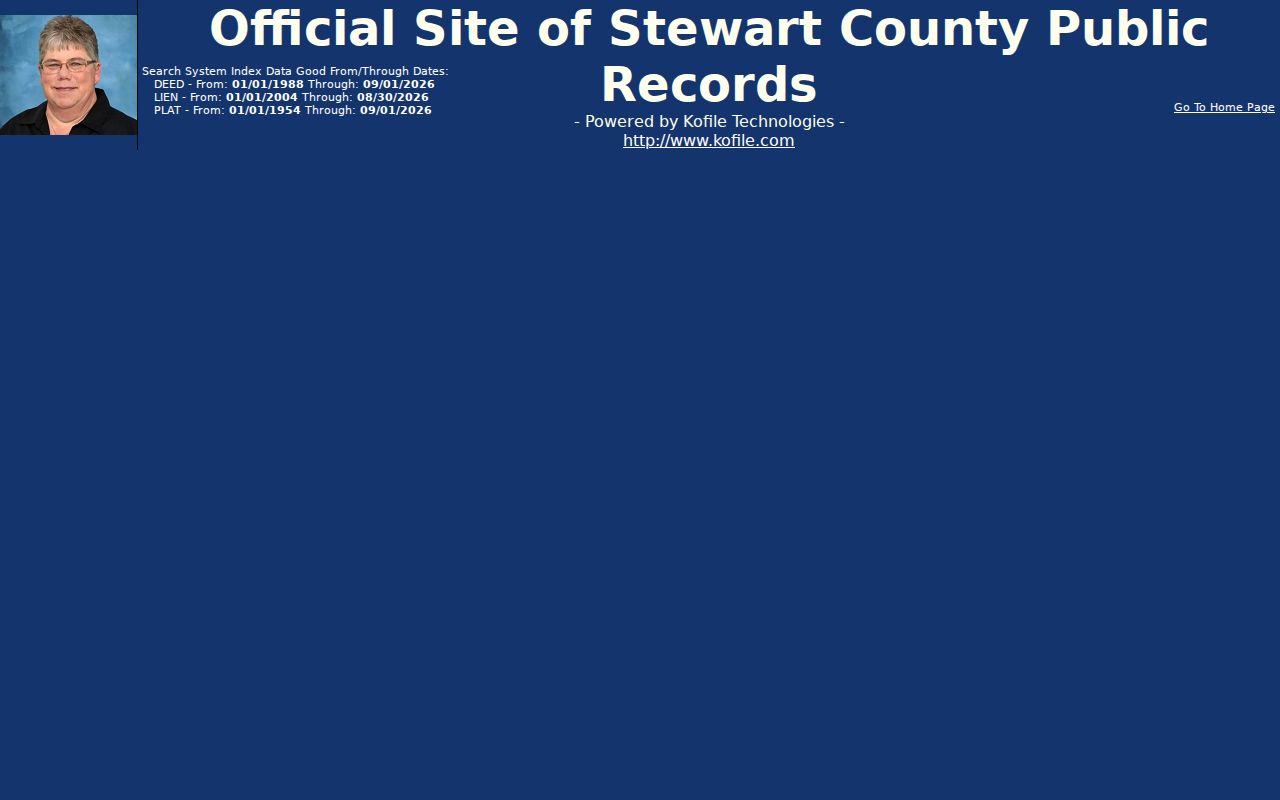
Those docket dates show which searches work online. They also mark the point where the Clerk or an archive becomes the better route for older deed records.
Search Stewart Deeds by Name
The local grantor-grantee form expects a party name in last-name-first order. Start broad. Narrow by date, role, or type. Search a former business name and its current entity name separately when an organization held the parcel.
| Control | Choices or format | How it helps |
|---|---|---|
| Name | Last name, then first name | Find recorded parties |
| Match Type | Starting With or Containing | Test exact starts and variants |
| Result Type | Instruments or Occurrences | Show records or count name appearances |
| Party Type | All, Grantor, Grantee | Separate transfers out from transfers in |
| Date range | Start and end dates | Limit results to a known period |
| Instrument Type | Docket-specific list | Isolate deeds, releases, easements, or other filings |
Ignore Spaces helps when indexing varies. Consideration From and To can narrow a query, but leaving them blank at first is safer. Names generally need three or more characters unless consideration fields are used. The official local name form shows these fields.
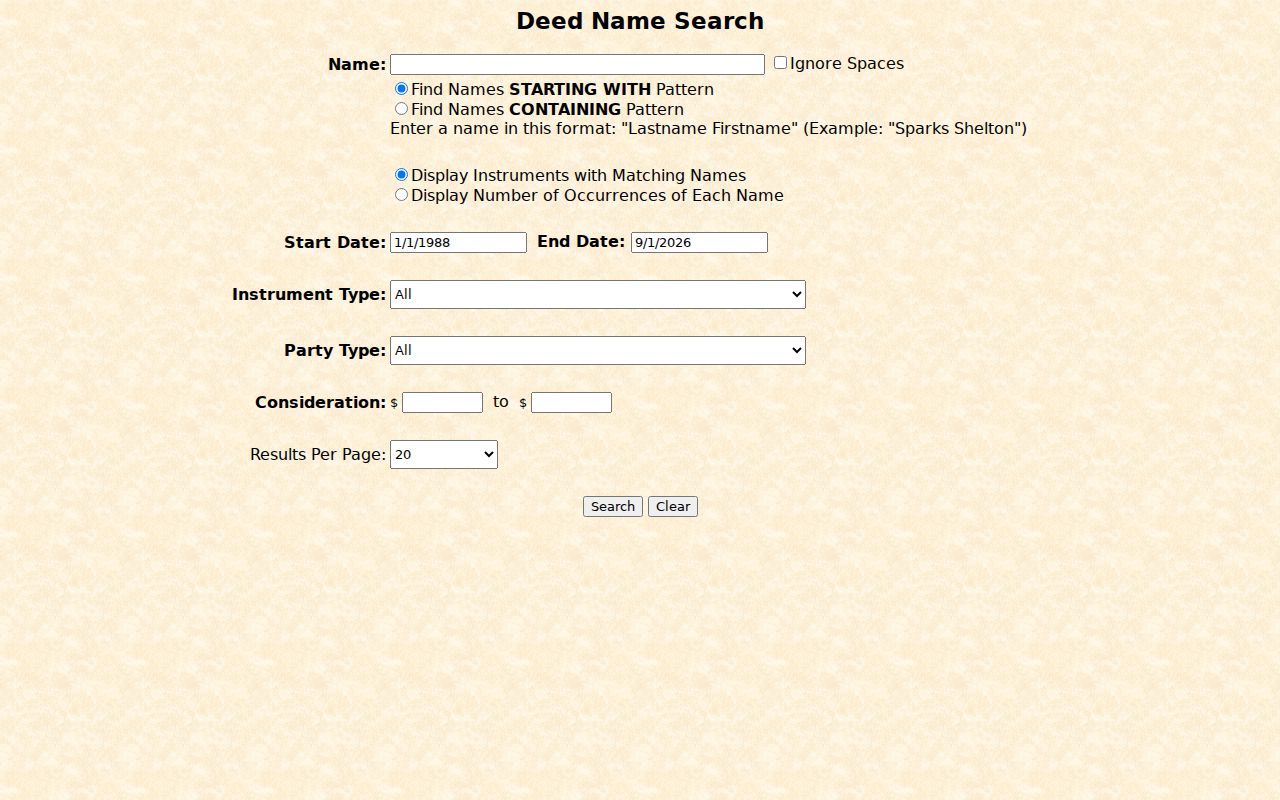
The screen separates matching, role, dates, type, and display. That structure supports a deliberate chain search through Stewart County deed records.
Build a Stewart County Deed Chain
A chain of title is the ordered set of conveyances for the same land. Work backward from a known current deed. Keep the legal description in view. A shared surname alone is never enough to link a person to the land.
- Find the current owner's acquisition instrument by searching that name as grantee.
- Read the deed or detail and record the grantor, filed date, book and page, and land description.
- Search that grantor as a grantee in an earlier date range to locate the prior acquisition.
- Repeat while matching the district, land lot, subdivision, lot, acreage, and prior-deed references.
- Move to Clerk-held books or archival microfilm when the chain predates local online coverage.
- Grantor
- The party transferring an interest.
- Grantee
- The party receiving an interest.
- Book and page
- The volume and page citation for a recorded instrument.
- Instrument number
- A clerk-assigned filing identifier, where present.
- Chain of title
- The linked sequence of recorded ownership transfers.
Note: Keep the signed date and the filed date separate, since execution and recording are two different events.
Inside a Stewart Deed Result
A Smith query returns 658 matches across 66 pages. That count is proof a surname needs parcel evidence. Entry ID 68781 is indexed as COVE. It cites Book 316, pages 107 to 110. Filed August 9, 2024 at 8:00 a.m., its detail lists grantors, grantees, property-field headings, and a cross-reference table. The official result table carries the full Smith result set.
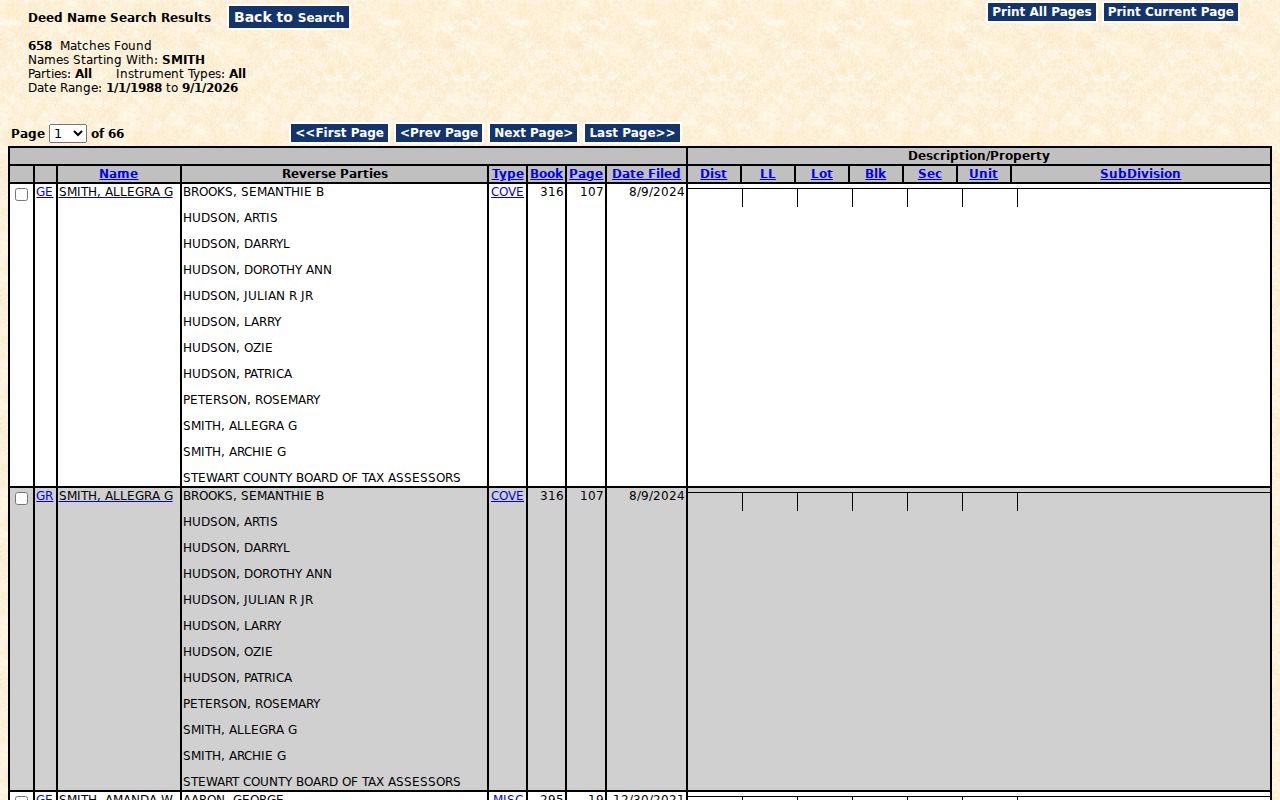
A result with several reverse parties carries a simple lesson. Open the detail first. Read who holds each role before linking any name to a parcel. The official instrument detail makes those roles concrete. It shows grantor, grantee, and any additional parties exactly as the clerk indexed them.
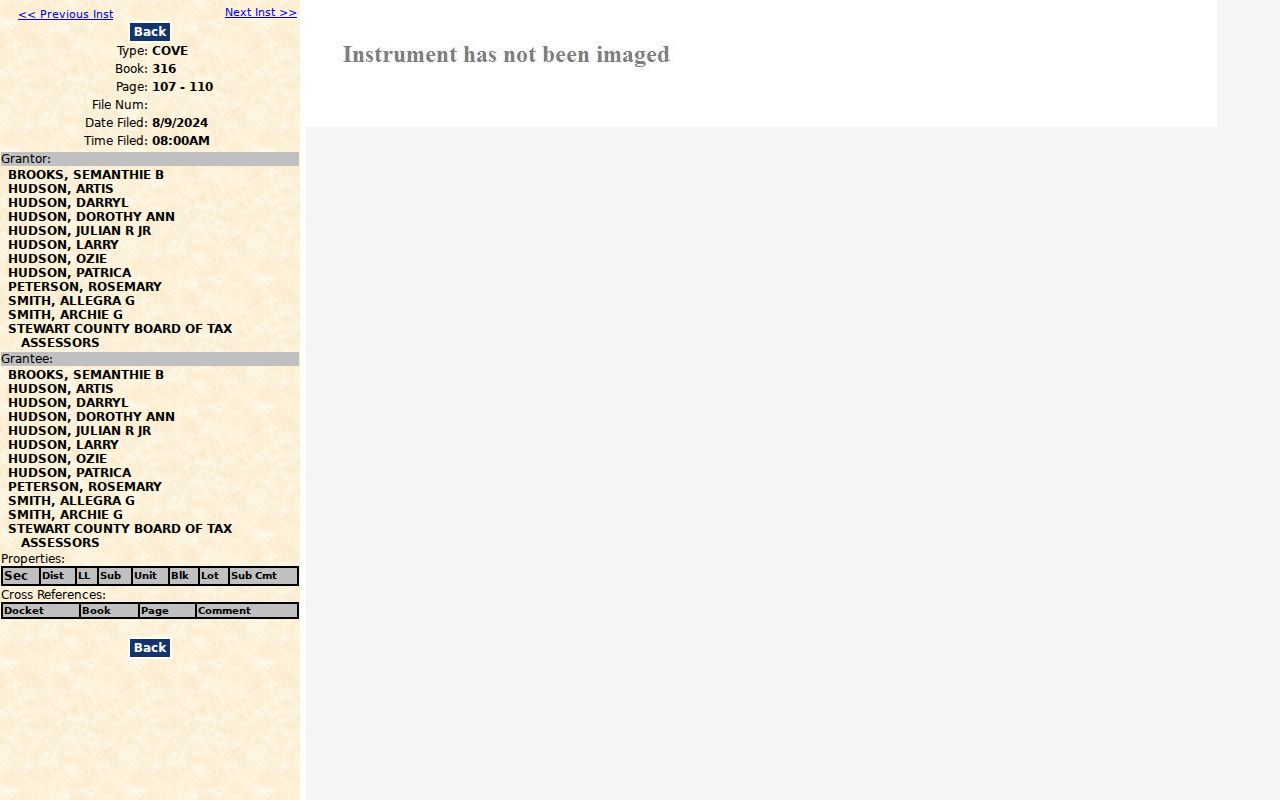
Its image path is blank. The citation still helps, but the covenant text has to come from the Clerk before anyone interprets its terms.
Find Stewart Deeds Without an Address
Kofile's Property Search has no street-address field. It runs on Section, Subdivision, District, Unit, Land Lot, Block, Lot, and Sub Comment instead. Copy those parts from an assessor card, a later deed, a plat, or a court order before searching Stewart County deed records. Book/Page works fastest when a later document cites the prior record. File Num and Instrument Number work too.
A plat may sit under a landowner's name. So search the Plat docket along with amended, corrective, re-subdivision, vacation, and dedication records. Estate land needs the widest net. Search executor, administrator, decedent, estate, and heirs. Kofile includes Deed From Estate, Court Order, Deed of Gift, Warranty Deed, Quit Claim Deed, and Release types. A will alone proves nothing about recording. Compare the probate authority with the capacity stated in the recorded conveyance before drawing conclusions.
Cross-Check Stewart Deed Records
The GSCCCA Real Estate Index offers a statewide cross-check. Its all-county real-estate coverage runs from 1999. Earlier historical data is still being added, and premium searches or images may require an account. Stewart sits out the optional property-description search. Reach for GSCCCA when a party owned land in more than one Georgia county. It also confirms a shaky local citation. For the Stewart instrument itself, return to Kofile and the Clerk, while the official GSCCCA property search illustrates the alternate plat route.
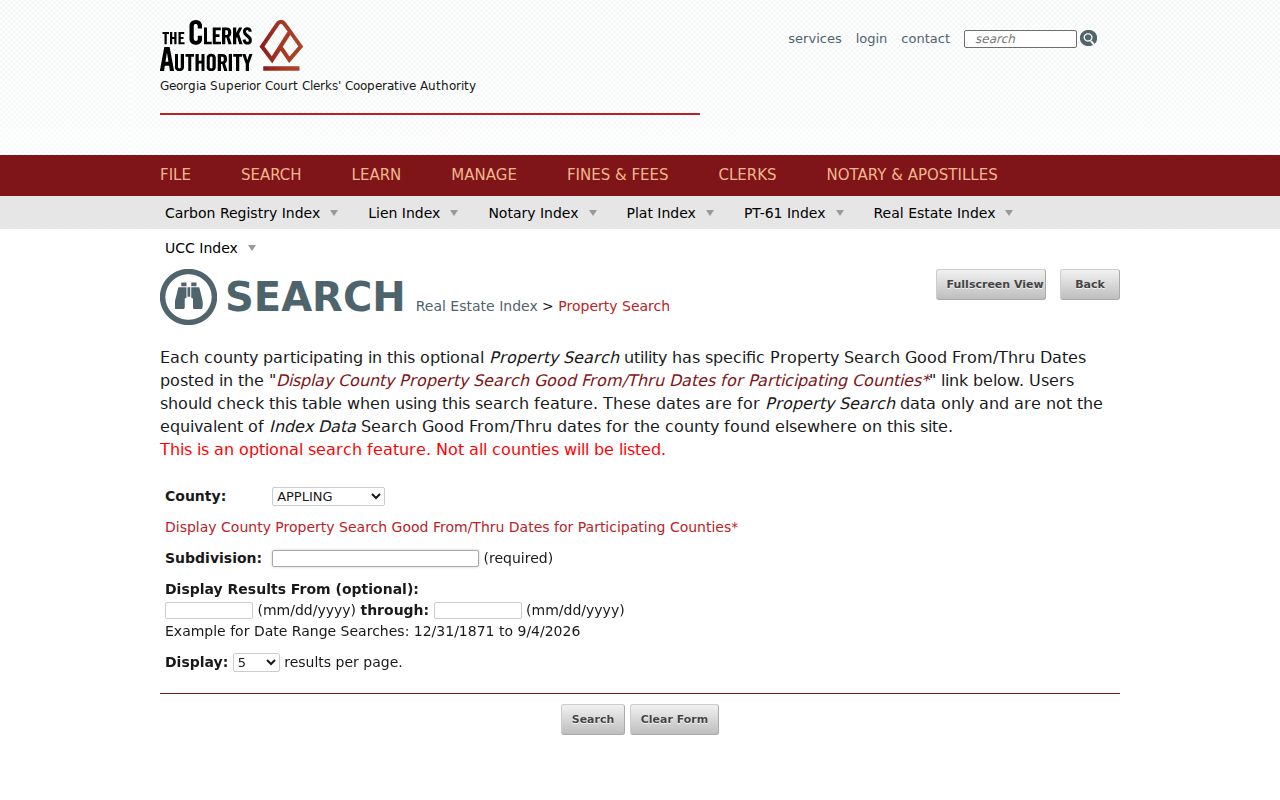
Treat the participation limit as a ceiling, not a verdict. It makes the screen a cross-check on Stewart County deed records, never proof that no record exists.
Stewart Deeds Before Online Coverage
Stewart County's courthouse burned in 1922. That loss shapes every search for older deeds here. The Georgia Archives county-card collection lists county microfilm and notes about record losses. It does not display the deeds themselves. Most county records remain locally held. Pre-1900 material may also surface through Archives or FamilySearch catalog routes. Start with the oldest reliable post-fire deed. From there, follow references into deed books, replacement indexes, tax books, probate files, plats, and neighboring conveyances. Mark each reconstructed link as an inference. Continue marking until a surviving official record supports it. The fire is not proof that every early deed vanished.
Note: Ask for a specific book, party, date range, and land description. Do not request a fresh title abstract.
Watch New Stewart County Filings
GSCCCA FANS sends free alerts. Alerts go out when new deed, lien, plat, UCC, or PT-61 activity matches your saved search criteria. That gives you early notice of a filing you did not expect. It stops nothing. Recording still proceeds, and title is never guaranteed by an alert. The official service page appears below.
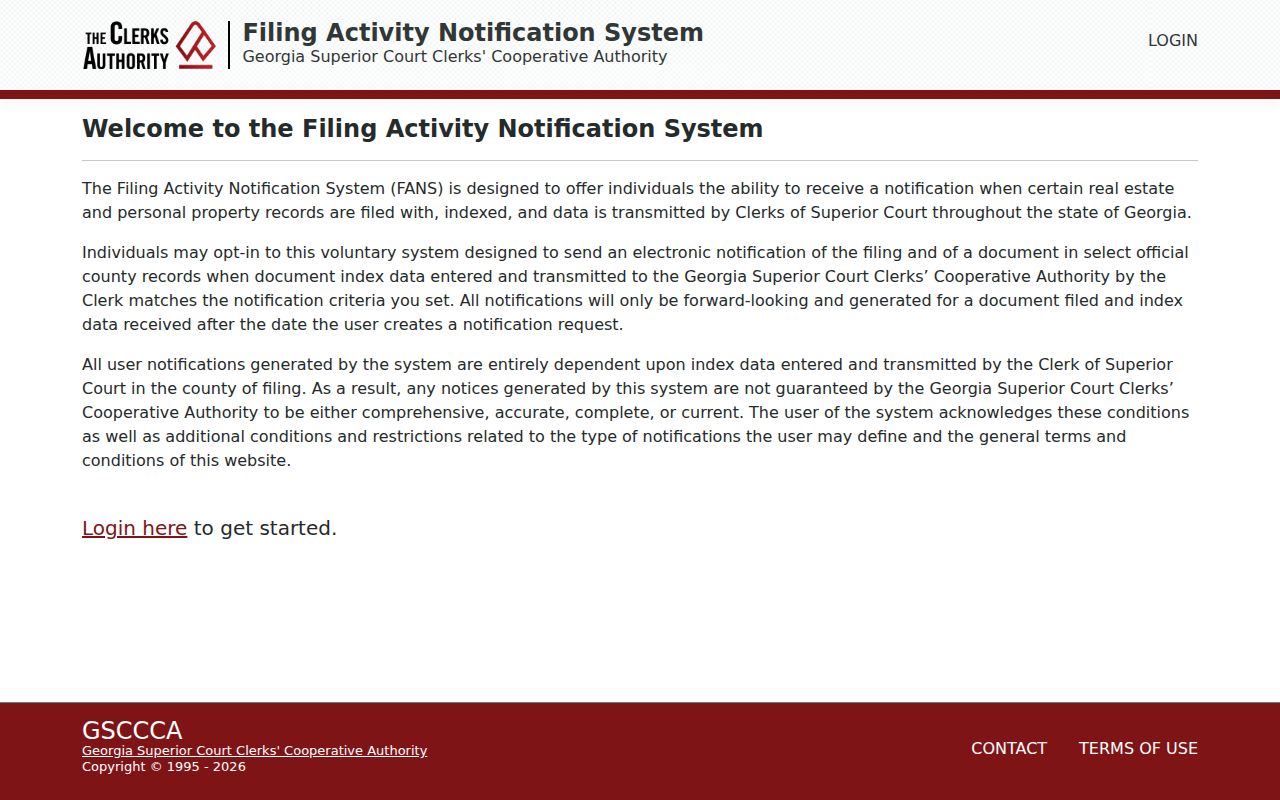
Let the alert lead you back to the indexed detail. Follow with the recorded image and direct contact with the Clerk, rather than a conclusion drawn from the notification alone.
Request a Stewart County Deed
The Superior Court Clerk sits at 1764 Broad Street, PO Box 157, Lumpkin, Georgia 31815, and answers at 229-838-6769. Decide upfront whether you need a plain or certified copy. When ordering, provide the grantor and grantee, instrument type, filed date, book and page, file number, and the parcel or legal description. Kofile states that its electronic database mirrors the land-record system in the Clerk's office and routes missing-image questions to ngasupport@kofile.com. Official sources do not publish current Stewart copy, certification, or online-image charges, so confirm the amount and accepted payment before ordering. Fallback channels include in-person books, phone, mail, email, and a precise Georgia Open Records request. Remember that the law does not require the custodian to create a title abstract. State your intended format clearly. A plain copy suits research, while a certified copy carries the Clerk's certification for formal use. Ask whether exhibits, riders, legal-description pages, and cross references are included. If an online detail cites a four-page range with no image, request all cited pages rather than only the first.
target_met
14 sentences, 7 short
Recorded is not guaranteed. An index or deed copy shows a filed instrument, but it is not a title opinion and may not reveal an unrecorded claim.