
Read Stewart County Property Tax Records
No single screen holds every tax fact. The Board of Tax Assessors sets taxability and value, the Tax Commissioner bills and collects and handles executions, and county and school authorities set the millage. Always keep the record year beside each number.
| Field | What the record establishes | Official source |
|---|---|---|
| Parcel and account | The assessed tax unit and lookup key | Stewart qPublic or Assessors |
| Fair-market estimate | The assessor's full-value conclusion for the tax year | Board of Tax Assessors |
| Assessed value | The taxable assessment base before applicable relief | Assessment record |
| Exemption | Relief attached to the account for that year | Assessors and current forms |
| Millage and bill | The levy and amount billed after the digest process | Tax Commissioner |
| Payment or execution | Collection status or delinquent-tax action | Tax Commissioner |
A tax bill is not a sale-price record. It is no title opinion either. The deed index answers conveyance questions, while the assessment file shows how the county placed a value and classification on the parcel.
Stewart Tax Offices Split the Work
The Stewart Tax Assessors office handles parcel assessment records, value notices, and exemption and appeal files. It also accepts property returns under local delegation. The office sits upstairs on the courthouse's north side, second floor. Hours run 8:00 a.m. to 4:30 p.m., Monday through Friday. Lunch closes the office from noon to 1:00 p.m. The phone number is 229-838-6220. The official Stewart assessor page mirrors these records online.
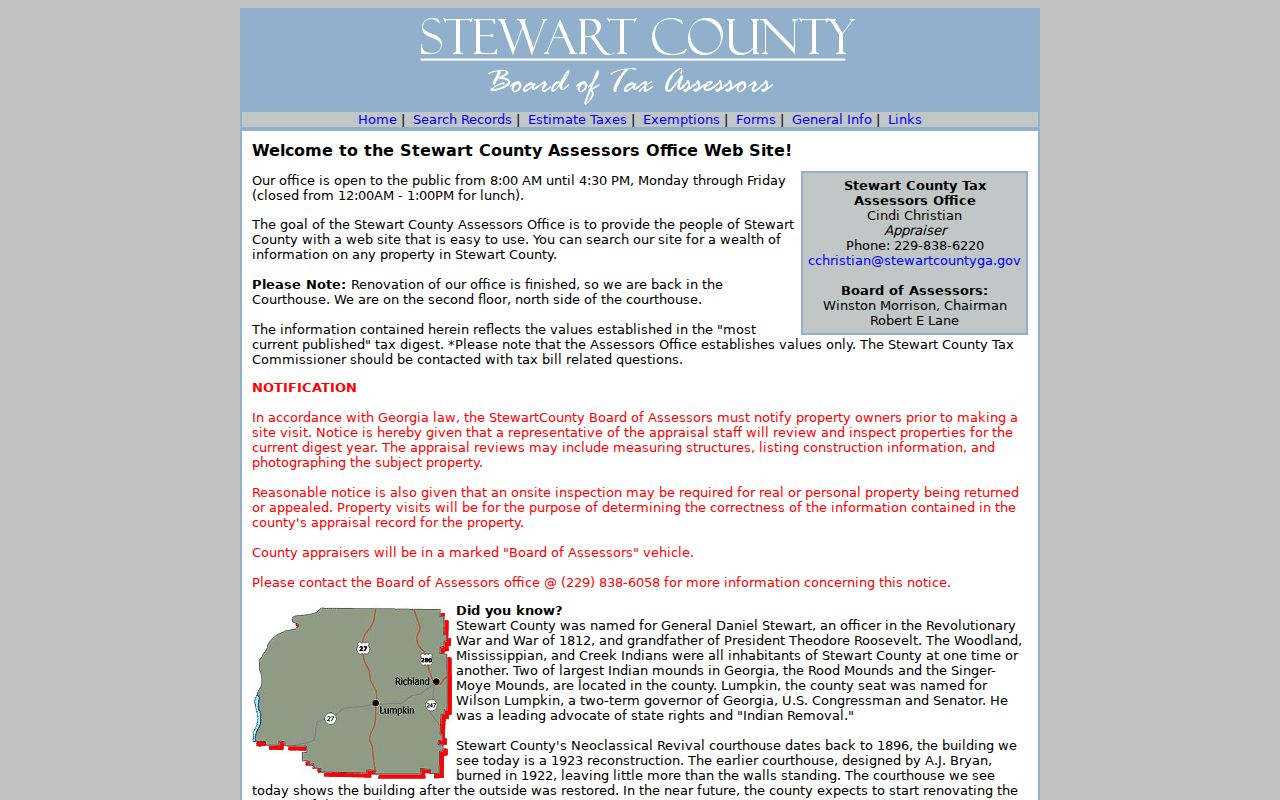
When the parcel application cannot be inspected, the Assessors office hands off tax cards and assessment files. The Tax Commissioner works in the same courthouse. Its address is 1764 Broad Street. That office handles bills, collections, payment status, and executions. An open-records request never extends a tax return or assessment appeal deadline, so route each question to the office that owns the record. The phone number is 229-838-4267.
Note: Give the parcel and tax year in every call so staff can separate the assessment record from the billing account.
Look Up a Stewart County Tax Bill
Start at the county-linked parcel application. It accepts an address, an owner name, a parcel number, or a legal-information key. Buttons and result fields may vary, so write down the parcel number it returns.
- Find the assessment account and copy its parcel number, owner display, tax district, and tax year.
- Open the county-linked tax address and confirm that it reaches a Stewart account search rather than a general landing page.
- Match the bill's parcel, year, exemptions, and billed amount to the assessment record.
- Call the Tax Commissioner for payment, correction, delinquency, execution, receipt, or tax-sale status.
For paying, the county-linked tax route leads to Government Window. It offers payments, not local parcel search fields.

A published access route is not a parcel balance. Confirm any payment, balance, or field detail with the Tax Commissioner before relying on it.
Stewart Tax Values Under Georgia Law
Georgia Department of Revenue valuation guidance says property is generally valued at fair market value as of January 1 and assessed at 40 percent of that value under O.C.G.A. §48-5-7. Fair market value means a bona fide arm's-length price, not a forced sale. Specialized rules can apply to conservation use, agriculture, timber, historic property, and other statutory classes.
That ratio does not mean a parcel will sell for a fixed multiple of its assessment. A recorded price can be nominal, related-party, non-arm's-length, or part of a special transfer. Read the assessment, deed, and transfer context separately.
- Fair market value
- The assessor's full-value conclusion for a tax date.
- Assessed value
- The statutory assessment base, generally 40 percent of fair market value in Georgia.
- Millage
- A tax rate applied through the levy process.
- Homestead exemption
- Qualifying relief tied to an owner-occupied legal residence.
- Tax lien
- A claim arising from unpaid tax, which must be checked with later releases and sale records.
Stewart Property Returns Use PT-50R
The Georgia PT-50R real-property return shows how detailed a tax filing can get. Georgia's general return period runs January 1 through April 1. Forms go to county officials. The Department of Revenue does not receive them. Stewart qPublic notes the Assessors receive returns as locally delegated.
| Identification | County, tax year, map and parcel ID, tax district, account number, covenant start year |
|---|---|
| Ownership | Prior and current owner, mailing address, and contact fields |
| Land | Property description, type, acres, class, and strata |
| Improvements | Description and taxpayer-stated prior and current values |
| Certification | Oath, signature, date, notary, and county processing fields |
PT-50R is a return, not a payment form. Because local contact pages and old form links can lag, confirm the current Stewart filing destination before mailing anything.
Stewart County Tax Digest Trend
The county's 2025 millage notice spans six years. Net digest value climbed from $177,870,616 in 2020 to $214,119,818 in 2025. Real and personal property value reached $261,243,005 in 2025. Exemptions totaled $61,491,342. The same table lists mobile homes, motor vehicles, and timber at 100 percent, with mobile homes at $1,731,784 and timber at $8,874,761 for 2025. These are countywide digest categories. They are not median sale prices or parcel-level values, and they should not be read as a Richland or Lumpkin appreciation rate.
Stewart Exemptions Need Current Forms
Stewart's exemption picture takes care. The local assessor page lists homestead, age-related, disabled-veteran, surviving-spouse, and deferral relief. It also covers agricultural or conservation-use and Freeport inventory relief. DOR's current Stewart facts list no local homestead additions beyond the statewide exemptions. Use current DOR exemption materials and confirm the tax year with the Assessors. Homestead rests on an owner-occupied legal residence. The first filing window runs January 1 through April 1. An ownership or name change may require refiling. Conservation use brings a ten-year covenant. Breaking it carries a penalty. The recorded covenant matters as much as any label on the tax card. So does parcel status.
Note: A reduced taxable value may reflect an exemption or special program, not a drop in the parcel's sale market.
Contest a Stewart County Assessment
Stewart County owners who disagree with an assessment can appeal the value, taxability, uniformity, or accuracy. The notice starts the clock. Georgia's PT-311A form captures the parcel details, notice information, and grounds, plus a choice of forum: Board of Equalization, hearing officer, or arbitration.
Strong evidence matters. A parcel card, comparable sales, photos, a recent appraisal, deed records, or proof that the property data is simply wrong can all support the case. File with the Stewart County Board of Tax Assessors, not the state Department of Revenue.
Remember what an appeal is not. It contests the assessment, never the millage rate. Unhappy with the outcome? Superior Court review remains a later route under Georgia procedure. The official appeal page appears below.
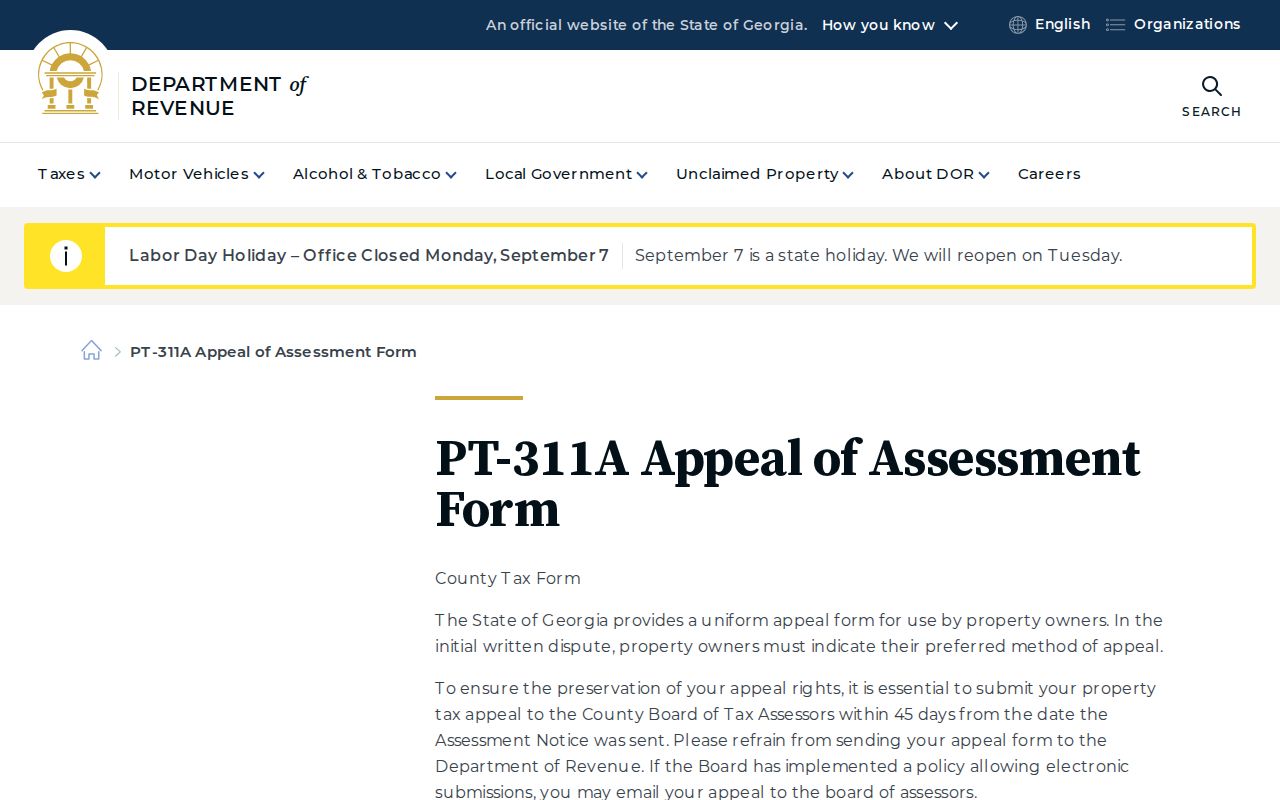
The page restates where the appeal goes and how the deadline works. Both run from the date on the mailed notice, so read that notice the day it arrives.
Appeal window. File the assessment appeal with the county Board of Tax Assessors within 45 days after the notice mailing.
Verify Stewart's 2025 Tax Statements
A county notice reported a software change. It was triggered after the former tax-software vendor went out of business. The change produced about 75 erroneous 2025 property-tax statements. The vendor was correcting them. The county directed questions to the Tax Commissioner at 229-838-4267.
If a Stewart County property tax account was affected, keep the original and corrected statements, payment receipts, correspondence, the parcel number, and dates. Confirm any balance directly with the office. Do not trust an old statement or portal screen.
Trace Stewart Delinquent Tax Records
A delinquent tax account in Stewart County can involve four offices. The Tax Commissioner holds the balance and execution information. The Sheriff keeps an execution docket and a book of court-processed sales. The Superior Court Clerk has the recorded tax-sale deeds and related court files. qPublic shows the assessment account on its own update schedule.
DOR's published facts for Stewart County cover interest timing. Bills allow 60 days from the postmark before interest starts. Still, confirm the due date printed on your actual bill. The county publishes no current tax-sale calendar, online sale roster, excess-funds list, or redemption instructions. Ask the responsible office for the specific record you need.
Request Stewart Property Tax Records
Start with the right office. The Assessors hold most of the valuation paperwork. That office handles tax cards, field sheets, value histories, map printouts, assessment notices, exemption files, and appeal records. The Tax Commissioner handles the bill itself. Think receipts, payment status, corrections, executions, and delinquent balances. The county also posts tax digests covering 2017 through 2025.
Georgia's Open Records Act, O.C.G.A. §§50-18-70 et seq., sets the clock. Agencies must generally respond within three business days for non-exempt records. Otherwise they must explain the cost, delay, or exemption. Request by parcel number, account, tax year, and named record. The agency need not produce a new valuation report. Older tax books may sit with the Clerk, local custodians, or Georgia Archives microfilm.
Keep everything in date order: notice, return, appeal, bill, correction, receipt. One parcel can generate records serving very different tasks. A posted digest may conflict with an individual account. In that case, ask the office which parcel record and tax year control. Do not derive a bill from countywide totals.