
Trace Stewart County Former Owners Through Each Transfer
A solid ownership history begins with a known parcel and the newest recorded deed. From there, work backward one conveyance at a time. Stewart County's local Kofile index supplies the modern bridge. Its deed docket starts January 1, 1988, and plat indexing reaches back to January 1, 1954. Older owners may require the Superior Court Clerk's books and Georgia Archives finding aids. Each source answers a different piece of the question. Keep full citations rather than a bare name.
| Source | Years It Covers | Where Held | What It Shows |
|---|---|---|---|
| Local Kofile deed index | 01/01/1988 to current good-through date | Online and Clerk office | Parties, instrument type, filed date, book and page |
| Recorded plat index | 01/01/1954 to current good-through date | Kofile and Superior Court Clerk | Subdivision, lots, blocks, roads and dedications |
| Older deed books and microfilm | Earlier periods, subject to surviving holdings | Clerk and Georgia Archives | Earlier conveyances and legal descriptions |
| Probate and tax material | Varies by series | Probate Court, local offices and archives | Estate transitions and year-by-year ownership clues |
Start online for any recent transfer. If the chain crosses the 1988 cutoff, ask the Clerk for the older book cited, or turn to the Georgia Archives county-card catalog to locate surviving microfilm. A tax roll can suggest who was assessed that year. But only a deed, estate instrument, or court-ordered transfer explains how title actually moved.
Stewart County’s 1988 Online Deed Cutoff
The Stewart Kofile coverage banner lists deeds indexed from January 1, 1988. The deeds run through September 1, 2026. The end date shifts as new filings load. For former owners, the start date matters more. A clean online chain may simply stop for a simple reason. The next deed sits in an older book. The earlier owner did not vanish.
Kofile also indexes liens from January 1, 2004 and plats from January 1, 1954. A release, security deed, estate deed, or subdivision plat may explain a change in ownership. Search each docket separately for those records. Certified-copy charges and portal image fees are not published in the official material. Ask the Superior Court Clerk before ordering anything.
Note: Record the banner’s good-through date with your notes because coverage is an operational snapshot, not a permanent promise.
Search Past Stewart County Owners in Both Party Roles
The local Kofile Name Search takes a name in "Lastname Firstname" order. Options include Starting With or Containing. They also cover Instruments or Occurrences, date range, instrument type, party type, consideration range, and result count. A former owner typically shows up first as grantee, then later as grantor. Searching only one role can hide half of that person's place in the chain.
| Control | Backward-chain use |
|---|---|
| Name and match type | Try indexed spelling, then spacing and containing variants |
| Grantor / Grantee | Test acquisition and later conveyance separately |
| Date range | Bracket the years suggested by the newest deed |
| Instrument type | Include estate, gift, quitclaim, warranty, sheriff and tax-sale deeds |
Entities, trusts, estates, and government bodies may carry a capacity label. Copy the name exactly, then test sensible variants. Same-name hits stay candidates until the parcel description, parties, and deed references line up. Only that match puts prior owners in the chain.
A Stewart County Instrument Detail Preserves the Trail
One indexed example, instrument 68781, shows why the detail view matters. The result row lists type COVE, Book 316, Page 107, filed August 9, 2024. The detail spans pages 107 through 110 and adds party, property, and cross-reference tables. A short row is only a locator.
The official instrument detail also reveals an access limit. Its image path comes back blank. This means an indexed filing can exist even when the scanned pages will not open online.
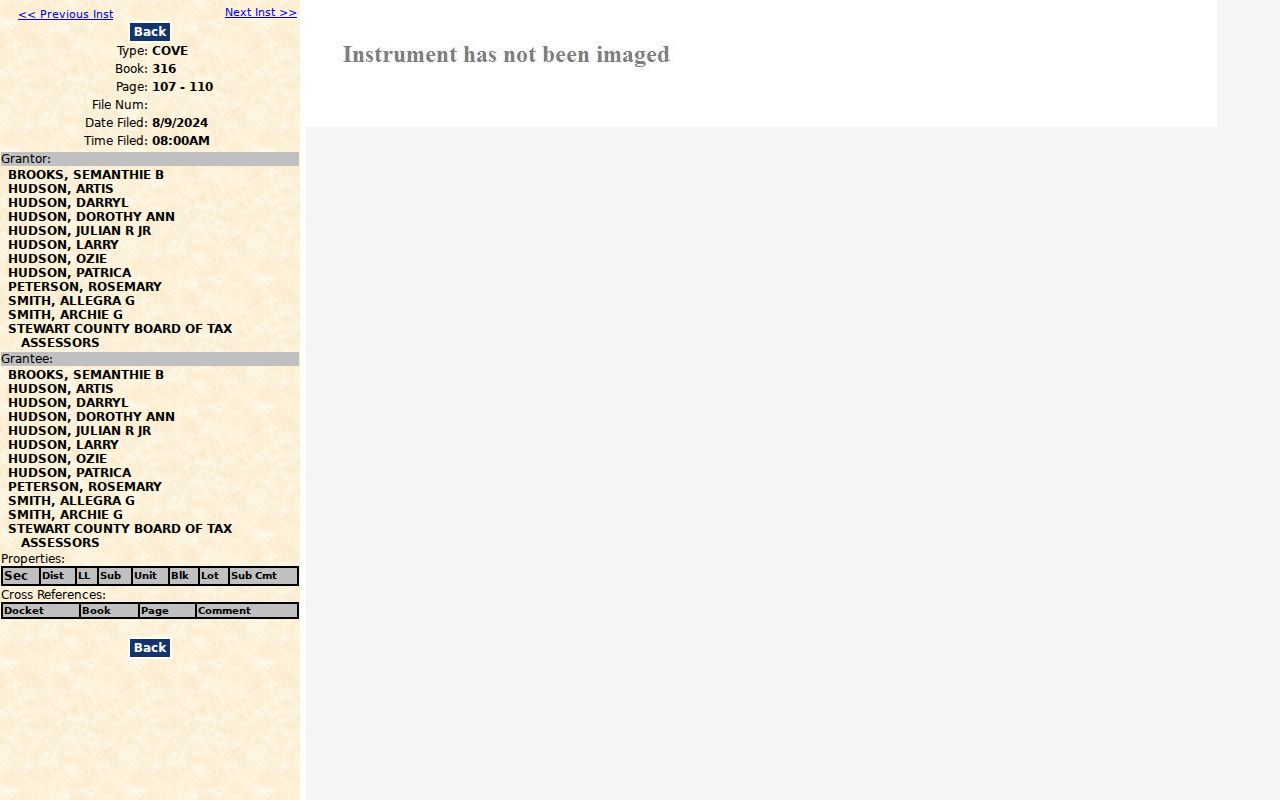
Use the book and page, filing date, party list, and any cross-reference to request the instrument from the Clerk. Read the actual pages first. Only then decide whether a covenant, release, or deed truly changed ownership.
Reconstruct a Stewart County Deed Chain Backward
Begin with the newest deed citation tied to the right parcel. The grantee became the owner. The grantor is the former owner to chase next. A prior-deed citation inside the instrument is the best shortcut. It points straight to the grantor's own acquisition. Without one, search that grantor as grantee in an earlier date range. Compare legal descriptions.
- Identify the parcel in qPublic and copy its legal description and latest deed reference.
- Open the newest deed, record its grantee, grantor, filing date, book/page, type, and prior reference.
- Search that grantor as an earlier grantee, then verify the same land description.
- Repeat until the chain crosses 1988, then continue through cited deed books or microfilm.
- Grantor / grantee
- The transferring party and receiving party named in an instrument.
- Chain of title
- The linked sequence of conveyances affecting the same land.
- Reverse index
- An index organized to help locate a party in the opposite deed role.
- Quitclaim / warranty deed
- Different conveyance forms whose legal effect must be read from the instrument.
Treat the chain as provisional until every link and description checks out. A shared surname, nominal consideration, or a tax-card name alone cannot bridge a gap.
Old Stewart County Descriptions Outlast Street Addresses
Kofile's property search has no street-address field. It uses Section, Subdivision, District, and Unit. It also uses Land Lot, Block, Lot, and Sub Comment. Date range, instrument type, and consideration complete the list. Translate a modern address through qPublic first. Then dig into the older records. Downtown Lumpkin deeds may cite a courthouse block or lot. Richland instruments may preserve Chisholm, railroad, Broad Street, or Depot Street language.
A plat can steady the chain when street names or mailing cities changed. Search the plat docket by subdivision, developer, surveyor, and owner. Then compare its lot, block, road, and easement labels against each deed. A mailing ZIP does not prove the parcel sat inside Lumpkin or Richland. It cannot fix the parcel's location at transfer time.
Estate and Court Transfers Can Break a Simple Owner List
Not every Stewart County parcel changed hands through a plain warranty deed. Kofile lists several local instrument types here. Deed From Estate, Court Order, Sheriff's Deed, Tax Sale Deed, Trustee's Deed, Deed of Gift, and Quit Claim Deed all appear. Each one turns up among Stewart County property records. A death in the family can push a transfer through probate first. Then the Stewart Probate Court file leads to the eventual deed from the estate. Foreclosures and tax sales leave an even deeper paper trail. Court orders, executions, sheriff sale records, confirmations, redemptions, releases, and the later deed layer one after another.
When searching, use the full party capacity. Search as executor, trustee, or administrator. Keep every probate or court citation next to its deed book and page reference. That pairing often explains a puzzle. Why did a former owner of record never show up as a normal seller? Want a closer look at the mechanics? The Stewart County deed records guide breaks down each instrument type.
The 1922 Courthouse Fire Changes Stewart County Research
Stewart County's own history records a courthouse fire. The 1896 building burned in 1922. Reconstruction finished in 1923. For anyone tracing old deed records, that disaster matters more than almost any other fact. It means survival must be tested book by book rather than assumed. The Georgia Archives notes that most post-1900 county material stayed local, though its county cards can point to microfilm and flag records lost to courthouse disasters.
Working backward, anchor the chain at the last secure post-fire citation. From there, compare replacement indexes against plats, probate files, tax rolls, and neighboring deeds. Historic newspapers help too. A name or sale notice in a genealogy scan is only a lead, though. It earns a place in the chain once it matches the recorded land description.
Measure the Reach of Stewart County Ownership Records
No published date fixes the earliest complete ownership chain for Stewart County. The honest answer is narrower. The online deed index starts in 1988. The online plat index reaches back to 1954. Anything older depends on the Clerk's surviving books and archive finding aids. When contacting an office, ask for a record series, volume, page, and format. Ask about known gaps too. That request works; asking staff to build a fresh ownership report usually does not.
In person, the Superior Court Clerk sits at 1764 Broad Street in Lumpkin. The phone line is 229-838-6769. A mail request should include the parcel description and party names. It should also carry approximate dates and any known book and page. Georgia's Open Records Act covers existing non-exempt indexes, maps, and records. It does not force an office to assemble a new chain of title. Libraries and archives add context. For reliance on a specific filing, get a certified Clerk copy of the deed.
Online cutoff. The deed index reaches only to January 1, 1988. Continue older-owner research through the Clerk’s deed books and verified archive holdings.
Tracing former owners suits a house history, an estate, boundary diligence, or a search for a recorded restriction. It should never be used to target a living person. And an assembled chain of Stewart County property records is not a title opinion.